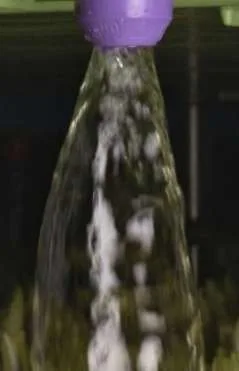
DURIT
A BUT OF OXYGEN FOR YOUR ENDIVES
In an effort to always provide an effective and lasting solution to your problems of reoxygenation and splashing, the Sté GODÉ, after 18 months of research in close collaboration with the École des Mines de Douai, launches the Durit Coanda for forcing tank.
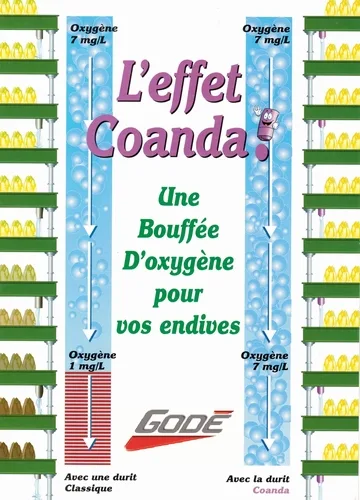
OXYGENATION OF ENDIVES
IMPORTANCE OF THE OXYGENATION FOR YOUR ENDIVE
Oxygen, an essential element for the growth of the endive, is provided by the nutrient solution at the top of each cell. The maximum possible concentration of oxygen is 8-10 mg/. This oxygen concentration depends on temperature, the higher the water temperature, the lower the oxygen dissolved in the water. At 19° the maximum dissolution of oxygen is 9 mg/l.
With a difficult batch, an endive bin collects between 1 and 1.5 mg of oxygen for a flow of about 8 l/min. So the oxygen will become scarce as we descend into the pile. It can then be seen that, gradually, asphyxiation gains the lower levels of the batteries. The presence of nitrite (NO2) in the nutrient solution is due to the removal of oxygen from nitrate (NO3) by bacteria.
This is the irreversible beginning of a complex and harmful physico-chemical phenomenon. This downward spiral will initially slow down and then stop the vegetation, sometimes resulting in loss of harvest. It is simply for these reasons that the degradations always start from the bottom and then spread to the rest of the pile, contaminating the whole cudier.
THE COANDA EFFECT
WHAT IS THE COANDA EFFECT?
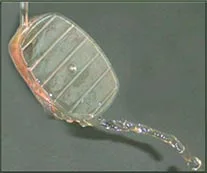
It is a very strange phenomenon of fluid mechanics, discovered by chance following a setback during an aeraulic experiment by the Romanian aerodynamic engineer Henri COANDA in 1911.Henri COANDA is now recognized as the father of the principle of jet aircraft, his work was recovered very early in the Second World War to lead to the first rockets. It is this Coanda effect or lift effect, which allows aircraft and birds to fly.
The Coanda effect is a physical phenomenon characterised by the adhesion of a liquid or gas to the support on which it flows. The experience shown above illustrates the phenomenon. Look how the water net adheres and follows the wall. As the fluid emerges, it tends to intimately embrace the contour of the room. Under certain conditions the fluid could even make "a hairpin turn". Imagine now this same experience at the exit of a circular shape, i.e. a nozzle. The result, you understand, is the principle of the duration Godé with Coanda effect.
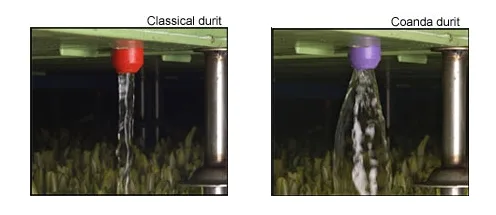
COMPARISON
BETTER PERFORMING THAN CLASSIC GODE DURIT
The Coanda durit forms a circular water film trapping an important air bubble. The water film is of larger diameter, its thinner thickness. This significantly increases the exchange surface between water and air on the outer surfaces, allowing for better reoxygenation of the nutrient solution.
PERFORMANCE
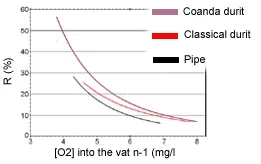
With low oxygen levels, the Coanda durit has a double reoxygenation rate compared to a conventional system. Comparison table of reoxygenation with a classical durit and a Coanda durit. Mass of water projected outside the endive tray in the form of splashes in 10 minutes.
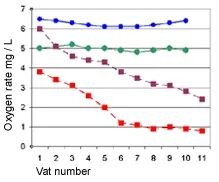
Comparison table of reoxygenation with a classical durit and a Coanda durit.
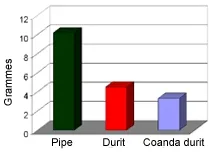
Mass of water projected outside the endive tray in the form of splashes in 10 minutes.